
The volatile, 24/7 nature of the digital asset market presents a unique challenge that human traders struggle to overcome. Unlike traditional stock markets with fixed trading hours, the world of cryptocurrency never sleeps, creating a relentless stream of data and potential opportunities. To navigate this high-frequency environment effectively, many sophisticated investors and institutions are turning to cryptocurrency trading algorithms. These automated systems are designed to execute trades based on a predefined set of rules, operating with a speed and discipline that is simply unattainable for a manual trader. By leveraging technology, traders can capitalize on market movements around the clock without being physically present at their trading terminals.
At its core, an algorithmic trading system, often referred to as a crypto trading bot, is a computer program that interacts directly with financial exchanges. It submits buy and sell orders on behalf of the user based on the instructions coded into its strategy. This could be as simple as buying Bitcoin when a specific moving average is crossed or as complex as a machine learning model that analyzes market sentiment from social media to predict price fluctuations. The primary goal is to remove the emotional component of trading—fear, greed, and hesitation—which often leads to poor decision-making.
These automated solutions empower traders to systematically test and deploy their strategies. Before risking a single dollar, an algorithm can be backtested against historical market data to gauge its potential profitability and weaknesses. This rigorous testing process allows for the refinement and optimization of trading logic, providing a level of analytical insight that is difficult to achieve through manual trading alone. As these tools become more accessible, understanding how they work, their benefits, and their inherent risks is no longer just for quantitative analysts; it’s becoming essential knowledge for anyone serious about succeeding in the crypto space.
This article will serve as a comprehensive guide to the world of automated crypto trading. We will dissect the mechanics behind these powerful algorithms, explore the most common strategies they employ, and weigh the significant advantages against the potential pitfalls. Whether you are considering using a pre-built platform or developing your own custom bot, you will gain the foundational knowledge needed to make an informed decision and approach algorithmic trading with confidence and a clear understanding of the landscape.
Understanding the Core Mechanics of Crypto Trading Algorithms

Before deploying any automated system, it’s crucial to grasp what goes on under the hood. Cryptocurrency trading algorithms are not “magic money machines”; they are sophisticated tools that operate on a logical framework of data analysis, signal generation, and order execution. Understanding these components demystifies the process and highlights the importance of a well-defined strategy.
The entire system is built upon a foundation of pre-programmed rules. A trader or developer defines a specific set of conditions that must be met for a trade to be initiated, managed, or closed. These rules are based on a trading strategy, which can incorporate a wide range of analytical tools. The algorithm’s primary job is to monitor the market tirelessly and act instantly when its programmed conditions are satisfied.
Data, Indicators, and APIs
An algorithm is only as good as the data it receives. These systems ingest vast amounts of real-time and historical market data to make decisions. Key data inputs include:
- Price and Volume Data: The most fundamental inputs, tracking the current price, historical prices, and trading volume of an asset.
- Technical Indicators: Algorithms heavily rely on mathematical calculations based on historical data. Common indicators include the Relative Strength Index (RSI) to identify overbought or oversold conditions, Moving Averages (MA) to determine trend direction, and Bollinger Bands to measure market volatility.
- Order Book Data: By analyzing the list of active buy and sell orders, an algorithm can gauge market depth and short-term sentiment.
To access this data and execute trades, algorithms connect to cryptocurrency exchanges via an Application Programming Interface (API). An API acts as a secure messenger that allows the trading bot to send and receive information from the exchange. Traders generate unique API keys from their exchange accounts, granting the bot permission to view account data and place orders without giving it withdrawal capabilities, which is a critical security measure.
The Three-Step Process
The operational flow of a typical trading algorithm can be broken down into three distinct steps:
- Data Analysis and Signal Generation: The algorithm continuously processes incoming market data and calculates technical indicators. When the market conditions align with the predefined rules of its strategy, it generates a trade signal. For example, a signal to “buy” might be generated if Bitcoin’s price crosses above its 50-day moving average while the RSI is below 30.
- Risk and Position Sizing: Upon generating a signal, a robust algorithm doesn’t just execute the trade blindly. It first runs a risk management check. This involves calculating the appropriate position size based on the account’s total capital and a predefined risk-per-trade limit (e.g., risk no more than 1% of the portfolio on a single trade).
- Order Execution: Once the signal is confirmed and the position size is calculated, the algorithm sends the order to the exchange via the API. This happens in a fraction of a second, ensuring the trade is executed at the desired price point before the opportunity vanishes. The algorithm then continues to monitor the position, managing it with stop-loss or take-profit orders until a signal to close the trade is generated.
Common Types of Cryptocurrency Trading Algorithms
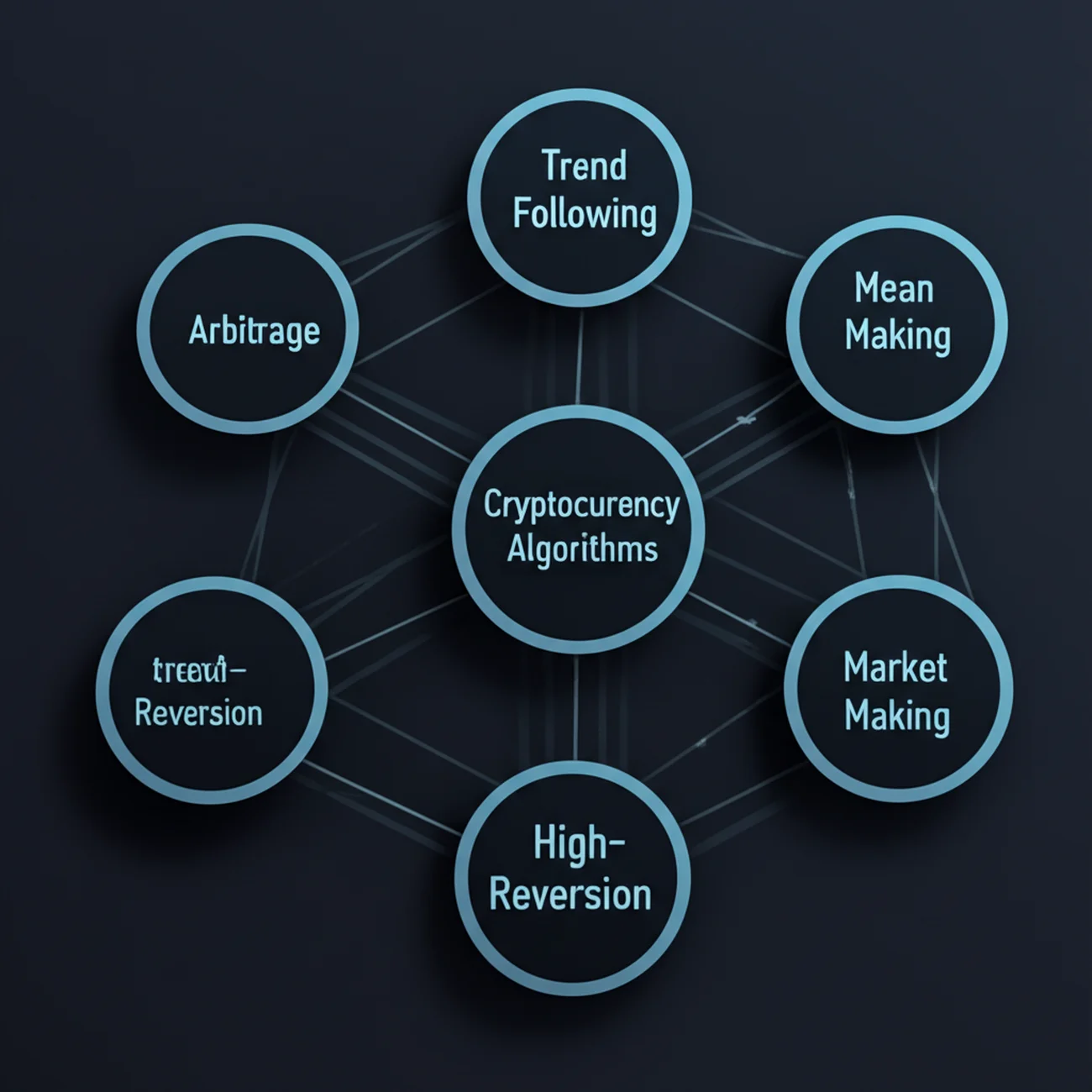
Not all trading bots are created equal. Different algorithms are designed to implement specific strategies, each suited for different market conditions and trader objectives. Understanding these variations is key to selecting or building a system that aligns with your financial goals and risk tolerance.
Arbitrage Bots
Arbitrage is one of the most popular strategies for algorithmic trading. The core concept is to exploit small price discrepancies for the same asset across different exchanges or trading pairs. For instance, if Bitcoin is priced at $60,000 on Exchange A and $60,100 on Exchange B, an arbitrage bot would simultaneously buy on A and sell on B to pocket the $100 difference. These opportunities are often fleeting, lasting only seconds, making them nearly impossible for humans to capture but ideal for high-speed algorithms. A more complex form, triangular arbitrage, involves exploiting price differences between three different cryptocurrencies on the same exchange.
Market Making Bots
Market makers are essential for a healthy financial market, and algorithms excel at this role. A market making bot provides liquidity to an exchange by continuously placing both a buy (bid) and a sell (ask) order for a specific asset. Their goal is to profit from the bid-ask spread, which is the small difference between the highest price a buyer is willing to pay and the lowest price a seller is willing to accept. While the profit on each individual trade is minuscule, these bots execute thousands of trades per day, allowing the small gains to accumulate into significant returns.
Trend Following Algorithms
This is a classic strategy where the algorithm is programmed to identify and follow the prevailing market trend. It operates on the principle of “the trend is your friend.” These bots use technical indicators like Moving Averages and the Average Directional Index (ADX) to determine if the market is in a clear uptrend or downtrend. When a strong uptrend is detected, the algorithm will open a long (buy) position and hold it until the indicators signal that the trend is reversing or losing momentum. Conversely, it will enter a short (sell) position in a downtrend.
Mean Reversion Algorithms
Mean reversion strategies are built on the statistical theory that asset prices and historical returns eventually revert to their long-term average or mean. An algorithm employing this strategy will identify an asset that has deviated significantly from its historical average. If the price is far below the mean, the bot will buy, anticipating a rise back toward the average. If the price is significantly above the mean, it will sell, expecting a decline. This strategy works best in markets that are range-bound or oscillating rather than strongly trending.
AI and Machine Learning Algorithms
The most advanced frontier of algorithmic trading involves Artificial Intelligence (AI) and Machine Learning (ML). Unlike algorithms with fixed rules, ML-based systems can learn from vast datasets and adapt their strategies over time. They can be trained to recognize complex patterns that are invisible to the human eye or traditional indicators. Some advanced bots even incorporate Natural Language Processing (NLP) to perform sentiment analysis, scraping social media and news sites to gauge market sentiment and predict price movements based on public emotion.
The Key Advantages of Using Automated Trading Systems

The shift towards automation in crypto trading is driven by a clear set of benefits that address the inherent limitations of human traders. Leveraging algorithms can provide a significant competitive edge in a market that is defined by speed and volatility.
Speed and Efficiency
In a market where prices can change dramatically in milliseconds, speed is paramount. Cryptocurrency trading algorithms can analyze market conditions, make decisions, and execute trades in a fraction of the time it takes a human to even process the information. This speed allows them to capitalize on fleeting opportunities, such as arbitrage or rapid price spikes, that are simply too fast for manual execution.
Emotionless Trading
One of the greatest obstacles to consistent profitability in trading is human emotion. Fear can cause a trader to exit a winning position too early, while greed can lead them to hold on to a losing trade for too long in the hope of a recovery. Automated crypto trading eliminates this emotional interference. The algorithm strictly adheres to its pre-programmed logic, executing trades based on facts and data, not on fear, greed, or a gut feeling. This disciplined approach is a cornerstone of long-term trading success.
24/7 Market Coverage
The cryptocurrency market operates 24 hours a day, 7 days a week, across a multitude of global exchanges. It is impossible for a human trader to monitor the market continuously without risking burnout and exhaustion. Trading bots, however, never sleep. They can run around the clock, scanning for opportunities and managing positions across different time zones, ensuring that no potential profit is missed while you are asleep or away from your computer.
Backtesting and Strategy Optimization
Perhaps one of the most powerful features of algorithmic trading is the ability to perform rigorous backtesting. A trader can take a promising strategy and test it against months or even years of historical market data. This process reveals how the strategy would have performed in the past, providing valuable insights into its potential profitability, maximum drawdown, and overall risk profile. Based on these results, the trader can refine and optimize the algorithm’s parameters to improve its performance before risking any real capital in a live market.
Navigating the Risks and Challenges of Algorithmic Trading

While the benefits are compelling, it would be naive to assume that algorithmic trading is a risk-free path to guaranteed profits. It comes with its own unique set of challenges and potential pitfalls that every trader must understand and manage carefully.
Technical Risks
An algorithm is a piece of software, and like any software, it can fail. A bug in the code, a lost internet connection, a server failure, or an unexpected change in an exchange’s API can cause the bot to malfunction. This could lead to it failing to execute a trade, executing the wrong trade, or being unable to close a position. Robust error handling, rigorous testing, and reliable hosting are essential to mitigate these technical risks.
Market Risks
Algorithms are designed to operate within a specific set of expected market behaviors. However, the crypto market is known for its extreme volatility and unpredictable “black swan” events, such as a major exchange collapse or a sudden regulatory crackdown. An algorithm programmed for a trending market may suffer massive losses during a sudden, violent market crash if its risk management protocols are not sufficiently robust to handle such outlier events.
Over-optimization (Curve Fitting)
A significant danger in the development process is over-optimization, also known as curve fitting. This occurs when a strategy is so finely tuned to a specific set of historical data that it performs brilliantly in backtests but fails miserably in a live trading environment. The algorithm effectively “memorizes” the past instead of learning generalizable patterns. To avoid this, strategies must be tested on “out-of-sample” data—a portion of historical data that was not used during the optimization phase—to ensure they are robust.
Security Concerns
Using a trading algorithm requires you to entrust it with your exchange API keys. If these keys are compromised, a malicious actor could gain control of your trading account. It is absolutely critical to follow security best practices:
* Never share your API keys.
* Restrict API permissions to trading only; never enable withdrawal permissions.
* Use trusted, reputable trading bot platforms or secure your own custom-built bot.
* Consider IP whitelisting for your API keys, so they can only be used from a specific IP address.
How to Get Started with Cryptocurrency Trading Algorithms

Embarking on your algorithmic trading journey can be approached in two primary ways, each catering to different skill sets and levels of desired control. The choice depends largely on your technical expertise, time commitment, and trading goals.
Option 1: Using Pre-built Trading Bot Platforms
For traders who lack programming skills or prefer a more user-friendly approach, third-party trading bot platforms are an excellent starting point. Companies like 3Commas, Cryptohopper, and Pionex offer web-based interfaces where users can easily configure and deploy a wide range of pre-built trading bots.
- Pros: These platforms are generally easy to set up, require no coding knowledge, and often feature a “marketplace” where you can copy the strategies of more experienced traders. They provide visual interfaces for building strategies and backtesting them.
- Cons: They typically come with a monthly subscription fee. You are limited to the strategies and indicators offered by the platform, which means less customization. Entrusting your API keys to a third-party service also introduces a layer of security risk that you must be comfortable with.
Option 2: Building Your Own Trading Bot
For tech-savvy traders with programming experience, building a custom trading bot offers the ultimate in flexibility and control. Python is the most popular language for this purpose due to its extensive libraries for data analysis (Pandas, NumPy) and connecting to exchange APIs (ccxt).
The development process generally involves these steps:
1. Define a Clear Strategy: Start with a simple, well-defined trading logic.
2. Choose a Language and Libraries: Set up your development environment with Python and relevant packages.
3. Connect to an Exchange API: Obtain API keys from your chosen exchange and use a library like ccxt to fetch data and send orders.
4. Code the Strategy Logic: Translate your trading rules into code.
5. Backtest Rigorously: Test your code against historical data to evaluate its performance and identify flaws.
6. Deploy and Monitor: Start with a very small amount of capital (“paper trading” or a live micro-account) and monitor its performance closely before scaling up.
- Pros: You have complete control over every aspect of the strategy, pay no subscription fees, and retain full custody of your API keys and code.
- Cons: This path requires a significant investment of time and a strong foundation in programming and quantitative analysis. The risk of coding errors is high and requires meticulous testing.
Conclusion
Cryptocurrency trading algorithms represent a powerful evolution in how traders can engage with the digital asset market. They offer undeniable advantages in speed, discipline, and efficiency, allowing individuals to execute complex strategies on a 24/7 basis without the interference of human emotion. From arbitrage and market making to sophisticated trend-following systems, these automated tools can unlock a new level of trading performance.
However, they are not a “set and forget” solution for generating wealth. Success in algorithmic trading is not found in the algorithm alone, but in the combination of a well-researched and robust strategy, rigorous backtesting, and diligent risk management. The risks—be they technical, market-related, or security-focused—are very real and demand respect.
Whether you choose the accessibility of a pre-built platform or the granular control of building your own bot, the journey requires continuous learning, adaptation, and a healthy dose of skepticism. By approaching algorithmic trading as a systematic and analytical discipline rather than a shortcut to easy profits, traders can effectively harness its power to navigate the complexities of the crypto market with greater precision and confidence.
