
Navigating the financial markets without a clear investing strategy is like setting sail across an ocean without a map or a compass. While stories of overnight millionaires from a single hot stock grab headlines, the reality of sustainable wealth creation is far less dramatic and infinitely more deliberate. It is a disciplined process, built on a personalized plan that guides your decisions, mitigates risk, and keeps your long-term objectives in focus, regardless of the market’s daily whims.
The primary purpose of a well-defined strategy is to act as a bulwark against your own worst enemy: emotional decision-making. The financial markets are driven by cycles of fear and greed, and without a guiding framework, it’s dangerously easy to buy high during euphoric peaks and sell low during panicked troughs. A solid plan grounds you in logic, helping you filter out the noise and stick to a course that is aligned with your personal financial goals, your tolerance for risk, and your unique time horizon.
This comprehensive guide will serve as your roadmap to mastering your own investing approach. We will deconstruct the fundamental components of any successful strategy, explore the most popular and time-tested methodologies, and provide a step-by-step framework for building a plan tailored to you. From understanding the power of asset allocation to recognizing the behavioral pitfalls that derail most investors, you will gain the knowledge and confidence to take control of your financial future.
What is an Investing Strategy?

An investing strategy is a systematic plan that guides an investor’s decisions in the selection and management of assets. It’s not about picking individual “winning” stocks; rather, it is a comprehensive set of rules and principles designed to achieve specific financial objectives. This plan acts as your personal investment policy, ensuring that every decision you make is cohesive and works toward a larger goal.
A robust strategy is built upon four key pillars:
- Financial Goals: What are you investing for? Common goals include retirement, a down payment on a house, funding a child’s education, or simply building long-term wealth. Your goals determine the required rate of return and the overall structure of your portfolio.
- Risk Tolerance: This is your emotional and financial capacity to withstand market fluctuations and potential losses. It’s a deeply personal metric influenced by your age, income stability, investment knowledge, and personality. An aggressive investor might be comfortable with high volatility for the chance of higher returns, while a conservative investor prioritizes capital preservation.
- Time Horizon: This is the length of time you have to invest before you need to access your money. A 25-year-old saving for retirement has a long time horizon and can afford to take on more risk than someone who is five years away from retiring.
- Asset Allocation: This is the practice of dividing your investment portfolio among different asset categories, such as stocks, bonds, and real estate. It is widely considered the single most important factor in determining your portfolio’s overall returns and risk level.
By defining these four components, you create a blueprint that dictates how you invest, what you invest in, and how you react to market changes. It transforms investing from a game of chance into a structured, goal-oriented process.
The Core Principles of a Successful Investing Strategy
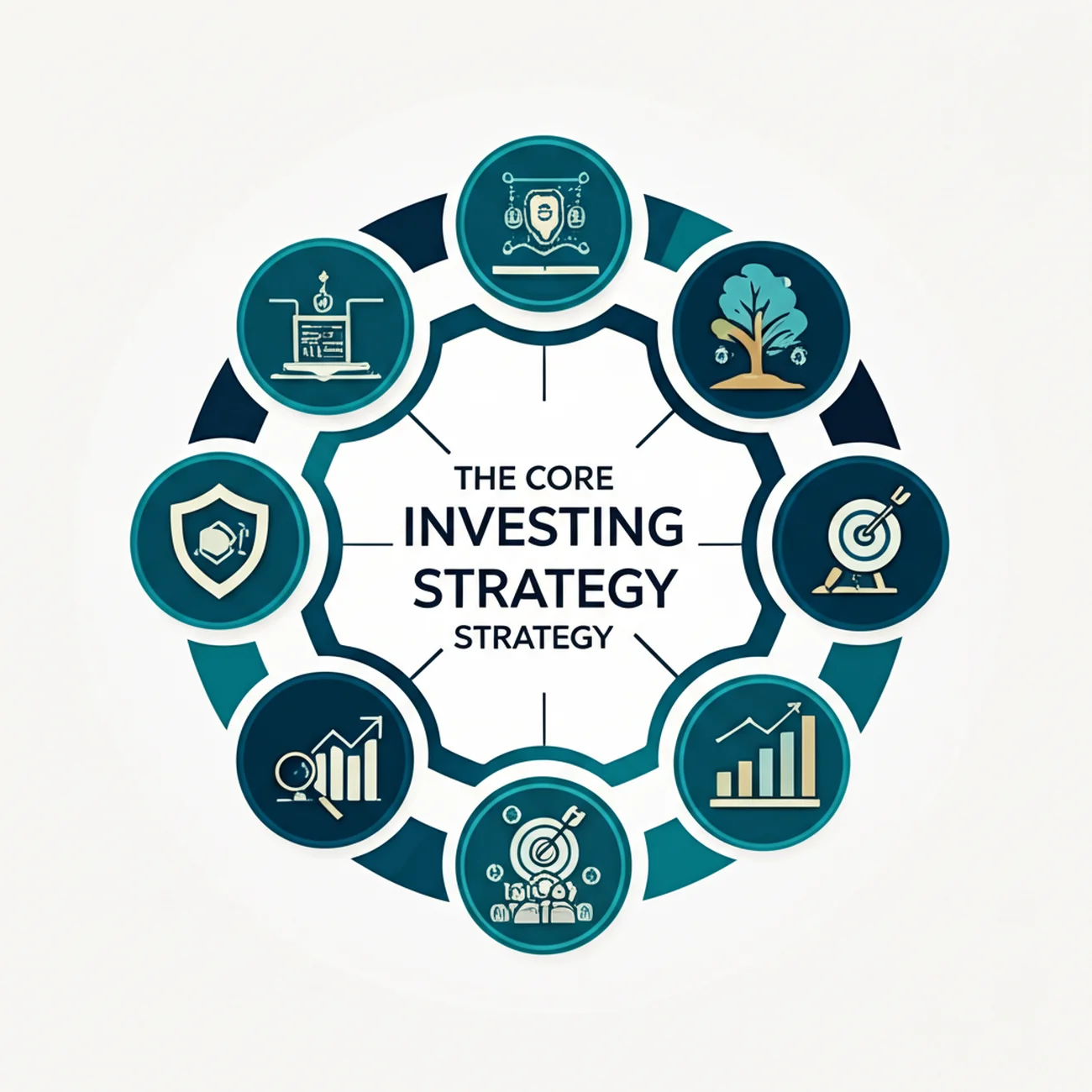
Before diving into specific types of strategies, it’s crucial to understand the foundational principles that underpin all successful long-term investing. These concepts are the building blocks upon which you will construct your personal plan.
Define Your Financial Goals
Your goals are the “why” behind your investing. They must be specific, measurable, achievable, relevant, and time-bound (SMART). “Investing for retirement” is a vague ambition; “accumulating $1 million for retirement by age 65” is a concrete goal. This clarity allows you to calculate how much you need to save and the average annual return required to reach your target. Separate your goals into short-term (1-3 years), mid-term (4-10 years), and long-term (10+ years), as this will directly influence the types of investments you choose for each.
Assess Your Risk Tolerance
Understanding your risk tolerance is about being honest with yourself. How would you react if your portfolio dropped 20% in a month? Would you panic and sell, or would you see it as a buying opportunity? Your risk tolerance is a blend of your ability to take risks (your financial situation) and your willingness to take risks (your psychological comfort level). Online questionnaires can provide a good starting point, but a deep self-assessment is key. A mismatch between your portfolio’s risk level and your personal tolerance is a primary reason investors abandon their strategies at the worst possible times.
Determine Your Time Horizon
Time is the most powerful tool an investor has. The longer your time horizon, the more you can leverage the power of compounding—the process of earning returns on your returns. A longer time horizon also allows your portfolio to recover from inevitable market downturns. Investments like stocks, which are historically more volatile but offer higher potential returns, are generally more suitable for long-term goals. Conversely, for short-term goals where capital preservation is paramount, less volatile investments like bonds or high-yield savings accounts are more appropriate.
The Power of Asset Allocation
Asset allocation is the strategic diversification of your investments across various asset classes. The main classes include equities (stocks), fixed income (bonds), and alternatives (real estate, commodities). These classes tend to behave differently under various market conditions. For example, when stocks are performing poorly, high-quality bonds often hold their value or even appreciate, providing stability to your overall portfolio. A well-diversified portfolio doesn’t eliminate risk, but it can significantly smooth out returns over time, protecting you from the volatility of any single asset class. The right mix for you depends directly on your goals, risk tolerance, and time horizon.
Popular Types of Investing Strategies
Once you understand the core principles, you can explore various established strategies. Many investors blend elements from different approaches to create a hybrid model that suits them best.
Growth Investing
Growth investors focus on companies that are expected to grow at an above-average rate compared to other companies in the market. These are often young, innovative companies in expanding industries like technology or biotechnology. The goal is capital appreciation, meaning the stock price goes up. Growth stocks typically reinvest their earnings back into the company to fuel expansion, so they often pay little to no dividends. This strategy carries higher risk, as high-growth expectations can lead to high valuations and sharp price drops if growth fails to materialize.
Value Investing
Pioneered by Benjamin Graham and popularized by his student Warren Buffett, value investing is the art of finding companies that are trading for less than their intrinsic, or underlying, worth. Value investors are like bargain hunters. They analyze financial statements to find solid, well-run companies that have been temporarily overlooked or unfairly punished by the market. The belief is that the market will eventually recognize the company’s true value, leading to a price increase. This strategy requires patience and a contrarian mindset.
Income Investing
The primary goal of income investing is to build a portfolio that generates a steady and predictable stream of cash flow. This income is typically derived from stock dividends, bond interest payments, or real estate rental income (e.g., through REITs). This approach is popular among retirees or anyone who needs their investments to supplement their regular income. While capital appreciation is a secondary goal, the focus remains on reliable payouts.
Index Fund Investing (Passive Strategy)
Index fund investing is a passive investing strategy that aims to replicate the performance of a broad market index, such as the S&P 500. Instead of trying to pick individual winners and beat the market, you simply buy the entire market (or a segment of it) through a low-cost index fund or ETF. This approach is built on the evidence that, over the long term, very few actively managed funds consistently outperform their benchmark index, especially after accounting for fees.
This strategy has been championed by legendary investors. In his 2013 letter to shareholders, Warren Buffett revealed his advice for the trustee of his estate: “Put 10% of the cash in short-term government bonds and 90% in a very low-cost S&P 500 index fund.” This simple allocation from one of the world’s greatest investors underscores the power of a passive, diversified, and low-cost approach. Furthermore, a Vanguard study titled ‘The Bogle Effect’ showed that the historical shift towards low-cost index funds saved investors an estimated $1 trillion in fees between 1985 and 2020, highlighting the significant financial advantage of this strategy.
How to Build Your Personal Investing Strategy

Building your strategy is a process of synthesizing the principles and types of strategies into a concrete, actionable plan.
Step 1: Lay the Foundation
Revisit the core principles. Write down your specific financial goals with target amounts and dates. Take an honest assessment of your risk tolerance. Clearly define your time horizon for each major goal. This foundation is non-negotiable and will guide all subsequent decisions. For example: “My goal is to save $500,000 for retirement in 30 years. Given my stable job and long time horizon, I have a high tolerance for risk.”
Step 2: Choose Your Core Approach and Asset Allocation
Based on your foundation, select a primary strategy. A young professional with a high risk tolerance might lean towards a growth-oriented or a 90/10 stock/bond index fund strategy. An investor nearing retirement might prefer an income-focused strategy.
Next, define your target asset allocation. A common rule of thumb is the “110 minus your age” rule, which suggests the percentage of your portfolio that should be in stocks. For a 30-year-old, this would mean an 80% stock and 20% bond allocation. This is just a starting point; you should adjust it based on your specific risk tolerance.
Step 3: Select Your Investments
With your allocation set, you can now choose specific investment vehicles.
* For Index Fund Investors: This is straightforward. You would select low-cost, broad-market index funds or ETFs that match your desired allocation (e.g., a total stock market fund and a total bond market fund).
* For Value/Growth Investors: This involves more research into individual stocks or actively managed funds that specialize in your chosen style.
* For Income Investors: You would look for high-dividend stocks, bond funds, or REITs.
The key is to ensure your selections align with your overarching strategy and asset allocation targets.
Step 4: Automate and Be Consistent
The most effective way to execute your strategy is to make it automatic. Set up recurring contributions from your bank account to your investment account. This implements a powerful technique called Dollar-Cost Averaging (DCA). By investing a fixed amount of money at regular intervals, you buy more shares when prices are low and fewer shares when prices are high. This removes emotion from the timing of your investments and ensures you are consistently building your portfolio.
The Importance of Sticking to Your Plan

Creating a strategy is only half the battle. The real challenge—and where most wealth is truly made or lost—is in the execution and discipline to stick with it through thick and thin.
The Dangers of Emotional Investing
Markets are volatile. There will be periods of exciting growth and terrifying declines. The natural human response is to become greedy during booms and fearful during busts. Acting on these emotions is the single biggest destroyer of long-term returns. Investors tend to chase hot performers (buying high) and panic-sell during downturns (selling low).
The data on this “behavior gap” is staggering. A 2023 study by J.P. Morgan Asset Management found that over the 20-year period ending in 2022, the average investor’s portfolio returned just 3.6% annually. In stark contrast, the S&P 500 returned 9.8% annually during that same period. The primary reason for this massive underperformance was not poor investment selection, but “behavioral pitfalls” like trying to time the market. Your written investing strategy is your best defense against this self-destructive behavior.
When to Rebalance and Review
Sticking to your plan doesn’t mean you set it and forget it entirely. Regular maintenance is required. Rebalancing is the process of periodically buying or selling assets in your portfolio to restore your original target asset allocation. For example, if a strong stock market run-up causes your 80/20 portfolio to become 90/10, you would sell some stocks and buy bonds to get back to your 80/20 target. This enforces a “buy low, sell high” discipline and manages risk. Most experts recommend rebalancing annually or whenever your allocation drifts by more than 5%.
You should also review your overall strategy annually or after major life events, such as a marriage, a new job, or the birth of a child. These events can change your goals, time horizon, or risk tolerance, necessitating a thoughtful adjustment to your plan. The key is to make changes based on shifts in your life, not in reaction to scary market headlines.
Conclusion
Mastering your investing strategy is a journey of self-discovery, education, and unwavering discipline. It begins with creating a personalized roadmap based on your unique goals, risk tolerance, and time horizon. Whether you choose a path of value, growth, income, or passive indexing, the defining characteristic of success is not the strategy itself, but your commitment to it. The evidence is clear: investors who create a sound plan and stick to it, tuning out the noise and avoiding emotional reactions, consistently outperform those who chase trends and panic during downturns.
By following the principles and steps outlined here, you can move beyond speculative guesswork and become a strategic, confident investor. Your written plan will be your anchor in the turbulent seas of the market, keeping you on course toward your most important financial destinations. Take the time to build your strategy today, automate your contributions, and let the powerful forces of compounding and discipline work for your long-term prosperity.
